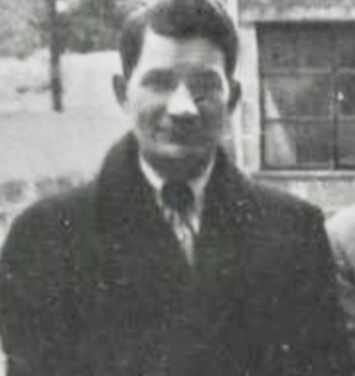
Peter Tyrrell
Peter Tyrrell (1916 – 26 April 1967) was an Irish author and activist against child abuse. When he was eight years old, the authorities sent him to St Joseph's Industrial School, Letterfrack, an institution run by the Christian Brothers. He was physically and sexually abused by the Christian Brothers until he was released from the school when he was sixteen. He became a tailor by trade, emigrated to the United Kingdom in 1935 and in the same year enlisted in the British Army. For four months in 1944, he was held as a prisoner-of-war in the German camp Stalag XI-B. Throughout the 1950s and 1960s, Tyrrell campaigned against corporal punishment and child abuse in industrial schools. In 1967, feeling that his efforts to enact change were unsuccessful, he burnt himself alive on Hampstead Heath in London. His remains went unidentified until 1968. In 2006, his autobiography Founded on Fear, which he had written between 1958 and 1959, was published posthumously by the Irish Academic Press after historian Diarmuid Whelan discovered the manuscript in the papers of politician Owen Sheehy-Skeffington, with whom Tyrrell had conducted a correspondence lasting seven years. Peter Tyrrell was born in 1916 to poor parents near Ballinasloe in County Galway, Ireland. He had nine siblings. James Tyrrell, his father, refused to help the family make money, so Peter's mother begged to support her children while the children scavenged their neighbours' fields for turnips, potatoes and other crops. The family lived on a farm, but their house (originally a stable) had a cobblestone floor, no windows and only two rooms. James Tyrrell neglected to make repairs or renovations to the house. In 1924, when Peter was eight years old, the authorities removed him and his three older brothers to St Joseph's Industrial School in Letterfrack, an industrial school operated and staffed by the Congregation of Christian Brothers, because of the family's poverty. Tyrrell's two younger brothers, who were too young for Letterfrack, were instead sent to live with nuns at a convent in Kilkenny. Tyrrell later recounted in Founded on Fear that many of the Christian Brothers who ran the school beat him and the other inmates daily and for no reason but the Brothers' "lustful pleasure". The Christian Brothers usually approached the boys from behind in order to beat them, taking them by surprise, and used, among other implements, sticks, leather and rubber. Boys would often be struck up to 20 times during a single beating. After Tyrrell's arm was broken during a beating he was coerced to tell the doctor that he had fallen down a flight of stairs. Sexual abuse also occurred; the children were often stripped naked before being beaten, and Tyrrell reported that he had been "sodomised by one of the Brothers". Students, including Tyrrell, who came from poor families were both bullied by their peers and singled out for abuse by the Christian Brothers. He related, though, that there were some Brothers who treated the boys kindly, and especially praised Brother Kelly, who was the superior of Letterfrack during Tyrrell's incarceration. Tyrrell believed that Kelly was unaware of the abuse but would have intervened had he been informed. The boys were forced to create goods and perform repairs for customers outside of Letterfrack in order to fund the school. Tyrrell was among several inmates assigned to the tailor shop, where he learned how to tailor. He sewed a double seat into his trousers to make the beatings less painful. The food, sanitation and living conditions were poor: the boys, who were underfed, were malnourished and always cold, and many suffered from chilblains and periodontal disease. The staff neglected to wash the boys' school uniforms regularly, and head lice was commonplace. In 1932, at the age of sixteen, Tyrrell was discharged from St Joseph's and returned home. James Tyrrell had renovated the house since his sons' departures (a concrete floor had replaced the cobblestone one, and windows had been added); however, Peter's eldest brother Mick built a new house into which the family moved sometime thereafter. Immediately after his return, Peter was hired as a tailor in Ballinasloe, where he sewed garments for a local mental hospital. Tyrrell's seven years at Letterfrack traumatised him. He reported that, for several years after his release, he startled easily, preferred to sit with his back against a wall out of fear of being beaten, avoided communicating with most people except for his mother and fell ill frequently. He remarked that he had a tendency to agree, out of fear that he may be harmed otherwise, with everything other people said. Because the people who mistreated him were men, Tyrrell preferred the company of women, writing that, "I have never met a bad woman. I have not known many good men. I dislike and fear men". Tyrrell once confided about his past in a priest, who expressed appallment that he complained about the Christian Brothers, as they had provided for his necessities. Adult life Tyrrell continued working in Ballinasloe until he emigrated to the United Kingdom in 1935. He cited attitudes by local people against former inmates of industrial schools, and his resultant inability to reintegrate into Irish society, as reasons for the move. He primarily lived in London. On 26 April, 1967, Tyrrell, disgruntled by the failure of his attempts to bring the issue of child abuse to the public eye, went to Hampstead Heath in London, poured petrol over his body and lit himself on fire. He was fifty or fifty-one years old. He suffered from psychological issues, including depression and possibly bipolar disorder, as a consequence of the abuse he endured and had previously contemplated suicide in 1939. His corpse, charred beyond recognition, was discovered, still smouldering, on 28 April by Robert Forsdyke, a member of the park staff. The body had abdominal wounds that may have come from a knife, though no weapon was found at the scene. Investigators initially believed Tyrrell to have been between 20 and 30 years old. The only clue as to his identity was a torn postcard, addressed to Sheehy-Skeffington, next to the body. In 1968, Scotland Yard contacted Sheehy-Skeffington inquiring about the postcard. Sheehy-Skeffington sent them a letter from Tyrrell for them to use as comparison, and Scotland Yard positively identified the remains as Tyrrell shortly thereafter. Source: Wikipedia.org
